


Quels sont les types de dialyseurs?
-
 2021-12-01
-
LEPU


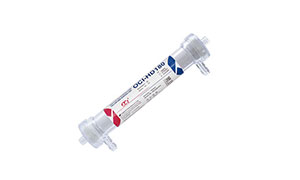
Le dialyseur est constitué d'une membrane de dialyse et de sa structure de support pour remplacer le rein. La membrane de dialyse est la partie principale du dialyseur, qui sépare le sang du dialysat. Pendant la dialyse, le sang et le dialysat s'écoulent dans des directions opposées des deux côtés de la membrane, et l'eau et les solutés sont échangés à travers la membrane semi-perméable. La performance du dialyseur détermine l'effet du traitement de dialyse et est un facteur de référence important pour le développement de programmes d'hémodialyse.
The characteristics of the Hémodialyseur are composed of two parts: design characteristics and working characteristics. Design features include the configuration of the Dialyseur, the pre-charge of the blood chamber and the dialysate chamber, the type of membrane, and the biocompatibility. Working characteristics include the transfer rate of different solutes and water. There are several classification methods for Dialyseurs.
Ⅰ. Classification selon la configuration du dialyseur
Dialyzers are divided into tube type, flat type, and hollow fiber type. At present, the commonly used Dialyseurs are hollow fiber type, and the flat-type and tube-type Dialyseurs used in the early days have been basically eliminated.
The Dialyseur à fibres creuses is composed of 8000-12000 hollow fibers, the fiber inner diameter is 200-300um, and the wall thickness is 2-30um. The hollow fibers are bundled into bundles and placed in the formed Dialyseur casing, and the casing and the dialyzing membrane are sealed with polyurethane. The blood flows through the hollow fibers, and the dialysate flows in the opposite direction outside the fibers.
Ⅱ. Classification selon le matériau membranaire du dialyseur
Selon le matériau de la membrane, les dialyseurs peuvent être divisés en 4 catégories:
1. Regenerated cellulose membrane Dialyseur, including copper imitation membrane and copper ammonia membrane Dialyseur. There are free hydroxyl groups on the surface of cellulose, which can react with blood components and has poor biocompatibility. After the Cupra treatment, the fiber surface is smoother and the biocompatibility is improved.
2. Acetate cellulose membrane Dialyseur. The cellulose is acetylated before the film is formed, which improves the biocompatibility and performance of the film.
3. Replace the fiber membrane Dialyseur. Blood imitation membrane is an alternative copper imitation membrane because its surface-free hydroxyl groups are covered by tertiary ammonia compounds, which have good biocompatibility.
4. Synthetic fiber membrane Dialyseur. Materials for this Dialyseur include polyacrylonitrile, polymethylmethacrylate, polysulfone, polycarbonate, polyethylene, and polyamide. They have a higher transport coefficient and ultrafiltration coefficient, better biocompatibility, but a higher price.
Ⅲ. Classification selon le coefficient d'ultrafiltration du dialyseur
According to the ultrafiltration coefficient, there are two different Types de dialyseur:
1. Low ultrafiltration coefficient Dialyseur. Ultrafiltration coefficient <15ml/(mmHg.h㎡), including copper imitation membrane, cuprammonium membrane, blood imitation membrane, and cellulose acetate membrane.
2. High-throughput and high-efficiency Dialyseur. Ultrafiltration coefficient> 15 ml/(mmHg.h㎡), has a very high removal rate for medium molecular weight substances and can remove large molecular weight β2-microglobulin and other macromolecular substances. Typical high-efficiency Hémodialyseurs include polysulfone membrane series, PAN membrane, PMMA membrane, and cellulose acetate membrane Dialyseur.
Vous pouvez également être intéressé par les produits suivants:
Si vous avez des questions, nous pouvons vous aider!